Insulation Calculator
Pick blown-in or batts. Blown-in uses Owens Corning's published AttiCat coverage chart for the R-value you want; batts use the coverage printed on the package, exactly as the label rates it.
How insulation quantities are calculated
Blown-in (attics): manufacturers rate blown insulation by bags per 1,000 sq ft for each R-value. Installing fewer bags than the chart means a lower R-value than the one on the bag. This tool encodes Owens Corning's AttiCat fact-sheet chart for its 28.5 lb bag: R-30 takes 15.3 bags per 1,000 sq ft (10.25 in settled), R-38 takes 19.5 (13 in), R-49 takes 25.8 (16.5 in). Bags = your area ÷ 1,000 × the chart rate, rounded up. Other brands' bags differ. If you're not using AttiCat, check your bag's own chart.
Batts: a batt package's coverage is printed on its label as gross square feet of product: packages = area × (1 + waste) ÷ sq ft per package, the standard way the label figure is used. Batt widths are made to fit the framing: 15 in wide batts fit 16 in on-center studs; 23 in batts fit 24 in on-center. Buy the width that matches your framing, and the R-value your climate zone calls for.
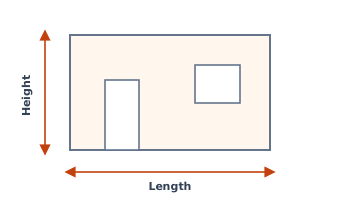
Attic areas are just length × width of the ceiling below. For walls, use the wall's length × height. Fiberglass in an existing attic can usually be blown right over. The chart rates the added R-value the same way. Hanging drywall over it afterwards? The Drywall Calculator counts sheets, mud and tape for the same walls.
Sources
The figures behind this calculator come from published manufacturer data and industry standards:
Worked examples
1,000 sq ft attic to R-38, blown-in
AttiCat chart: 19.5 bags per 1,000 sq ft at 13 in settled depth.
Buy 20 bags
1,200 sq ft attic to R-30, blown-in
15.3 bags per 1,000 sq ft × 1.2 = 18.4 bags.
Buy 19 bags
500 sq ft of walls, batts at 90 sq ft/pkg
500 × 1.10 (waste) ÷ 90 sq ft per package = 6.1 packages.
Buy 7 packages
Frequently asked questions
How many bags of blown-in insulation do I need for 1,000 sq ft?
What R-value should my attic have?
What size batts fit 16 in on-center studs?
Can I blow new insulation over old insulation?
Does the calculator include the rental blower?
Related calculators
Paint Calculator
Gallons and quarts for a room, with doors, windows and coats accounted for.
Brick Calculator
Bricks and mortar bags for a wall, by brick size.
Drywall Calculator
Sheets, mud and tape for walls and ceilings.
Wallpaper Calculator
Rolls to buy, allowing for pattern repeat.
Estimate disclaimer: results are planning estimates based on standard manufacturer yields and coverage figures. Site conditions, product choice and installation method change actual quantities. Verify before you buy, and follow local building code for structural work. This tool does not replace professional engineering advice.
Use this calculator on your own site
Free to embed. Paste this code where you want the calculator to appear. It carries a small "by Figure My Build" credit link, which is all we ask.