Concrete Volume Calculator
Whatever the shape of the pour, a rectangular slab or a round pad or footing, get the volume in cubic yards for ordering ready-mix, plus the bag count if you'd rather mix it yourself.
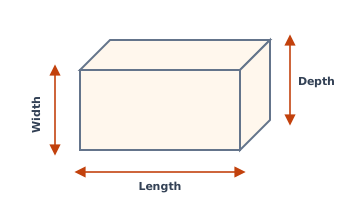
How the volume is calculated
For a rectangular pour, volume is length × width × thickness, with thickness converted from inches to feet. For a round pour it's the cylinder formula: π × (diameter ÷ 2)² × depth. Multiply by the number of identical pours, then divide cubic feet by 27 to get cubic yards.
Ready-mix is sold in quarter-yard steps, so the order figure adds your waste allowance and rounds up to the nearest 0.25 cu yd, the same convention the Concrete Slab Calculator uses. The bag alternative uses the yields both Quikrete and Sakrete publish: an 80 lb bag makes 0.60 cu ft, a 60 lb bag 0.45 cu ft, a 40 lb bag 0.30 cu ft.
For a specific slab with costings, use the slab calculator; for bags only, the Concrete Bag Calculator goes deeper on bag choice. For post holes and round footings specifically, the Post Hole Calculator counts bags per hole.
Sources
The figures behind this calculator come from published manufacturer data and industry standards:
Worked examples
20 × 12 ft pour, 6 in thick
120 cu ft = 4.44 cu yd exact. 10% waste, quarter-yard rounding.
Order 5 cu yd
Round pad, 10 ft across, 12 in deep
78.5 cu ft = 2.91 cu yd exact. 10% waste, or 192 × 60 lb bags.
Order 3.25 cu yd
Two 12 × 8 ft slabs, 4 in thick
64 cu ft combined = 2.37 cu yd exact. 10% waste.
Order 2.75 cu yd
Frequently asked questions
How do I convert cubic feet of concrete to cubic yards?
How much concrete does a round footing need?
Why order more than the exact volume?
When is ready-mix better than bags?
Related calculators
Concrete Bag Calculator
How many 40, 60 or 80 lb bags of concrete you need, and what they'll cost.
Concrete Slab Calculator
Cubic yards of ready-mix for a slab, plus the bag count if you mix it yourself.
Concrete Block (CMU) Calculator
Blocks and mortar bags for a block wall.
Rebar Calculator
Rebar pieces and grid layout for a slab.
Estimate disclaimer: results are planning estimates based on standard manufacturer yields and coverage figures. Site conditions, product choice and installation method change actual quantities. Verify before you buy, and follow local building code for structural work. This tool does not replace professional engineering advice.
Use this calculator on your own site
Free to embed. Paste this code where you want the calculator to appear. It carries a small "by Figure My Build" credit link, which is all we ask.