Waste Allowances: How Much Extra to Order
Every material wastes differently, and the right extra percentage depends on the job, not on a single rule of thumb. These are the planning ranges behind our calculators, and the reasons for each.
Why waste happens
Cuts and breakage are the obvious part. The quiet part is everything else: forms that aren't perfectly level, mix left in the wheelbarrow, a subgrade that dips, the board with the knot exactly where your cut lands. A waste allowance is you pricing those certainties in advance, which is cheaper than a second trip mid-job.
The ranges, material by material
| Material | Standard allowance | Go higher when… |
|---|---|---|
| Concrete | 10% (industry ordering guidance runs 4–10%) | Irregular shapes, rough subgrade: use 15% |
| Tile | 10% straight layout | 15% diagonal, 20% patterned layouts |
| Rough lumber | 10–20% | Surfacing rough stock, defect-heavy boards |
| Brick & block | Built into mortar + unit waste options | Lots of cuts around openings |
| Decking | 10% | Diagonal patterns, decks wider than the board length |
Concrete: the sourced number
Concrete is the one material where the allowance comes from the industry itself: ready-mix ordering guidance runs about 4–10%, and 10% is the standard planning figure for flatwork. The Concrete Bag Calculator and Slab Calculator default to it, and let you change it.
Tile: the layout decides
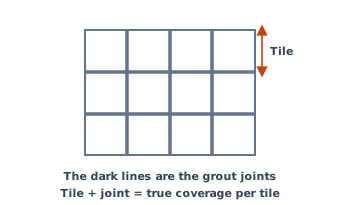
A straight tile grid wastes about 10% to cuts. Turn the tiles diagonal and every edge becomes a cut: 15%. Patterned layouts with small pieces climb to 20%. The Tile Calculator presets exactly these three figures so the pattern you pick sets the allowance for you.
Paint is the exception
Paint doesn't waste the way solids do. A gallon covers about 350 sq ft per coat, and the real question is coats, not breakage. Our Paint Calculator converts the exact amount into whole gallons plus quarts, so a room needing 2.16 gallons reads as "2 gallons + 1 quart" instead of forcing a third gallon you'll store for a decade.
The rule underneath all of it
Order for the job you actually have: first-time installer, awkward room, or a pattern with many cuts all argue for the top of the range. Every calculator on this site shows its allowance openly and lets you set it to zero if you'd rather run lean. The number is yours; we just refuse to hide it.
Calculators in this guide
Concrete Bag Calculator
How many 40, 60 or 80 lb bags of concrete you need, and what they'll cost.
Tile Calculator
Tiles and boxes to buy, with grout-gap spacing and cutting waste included.
Board Foot Calculator
Board feet from lumber dimensions, plus cost.
Paint Calculator
Gallons and quarts for a room, with doors, windows and coats accounted for.
Every figure in our guides comes from the same manufacturer and industry sources as the calculators. See How We Calculate.