How Many Bags of Concrete Do I Need?
The honest answer is a chain: measure the pour, turn it into cubic feet, divide by what one bag actually makes, then add waste. Here is every link in that chain, with the published figures behind it.
Start with what one bag makes
A bag of concrete mix doesn't fill its weight in volume. Once mixed, each size yields a fixed amount. Both QUIKRETE and Sakrete publish the same yields:
| Bag size | Makes (mixed) | Bags per cubic yard |
|---|---|---|
| 80 lb | 0.60 cu ft | 45 |
| 60 lb | 0.45 cu ft | 60 |
| 40 lb | 0.30 cu ft | 90 |
The Concrete Bag Calculator works from exactly this table. The manufacturers' own data sheet is linked in its Sources block.
The maths, on a real slab
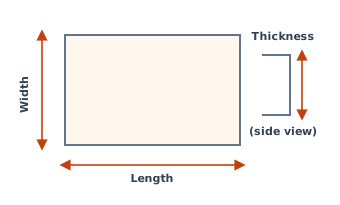
Take a 10 × 10 ft slab, 4 in thick. Volume = 10 × 10 × (4 ÷ 12) = 33.3 cu ft. Divide by the 80 lb yield: 33.3 ÷ 0.60 = 56 bags with nothing spare. Add the standard 10% waste allowance and the buy-list reads 62 bags. At 6 in thick the same slab needs 92 bags, which is why thick slabs usually stop being a bag job.
Bags or ready-mix?
- Under about half a cubic yard: bags are cheaper and simpler: post holes, small pads, repairs.
- Past one cubic yard: ready-mix usually wins once your time and mixing effort count, and it's far less physical work.
- Between the two, price both: the Concrete Slab Calculator shows cubic yards and the bag equivalent side by side.
How thick should the pour be?
Typical thicknesses: 4 in for patios, walkways and shed bases; 5–6 in for driveways that carry vehicles. Anything structural follows local code and engineering, not a guide.
The waste allowance isn't a guess
Forms are never perfectly level and some mix always stays in the wheelbarrow. The ready-mix industry's own ordering guidance runs about 4–10%; 10% is the standard planning figure for flatwork, and 15% is safer for irregular shapes or rough subgrade. Our waste allowance guide explains the ranges material by material.
Round shapes and post holes
Footings and post holes are cylinders, not boxes. The Post Hole Calculator counts bags per hole so a fence run adds up correctly, and the Concrete Volume Calculator handles mixed shapes when you're planning the order.
Calculators in this guide
Concrete Bag Calculator
How many 40, 60 or 80 lb bags of concrete you need, and what they'll cost.
Concrete Slab Calculator
Cubic yards of ready-mix for a slab, plus the bag count if you mix it yourself.
Concrete Volume Calculator
Cubic yards and cubic feet for any pour shape.
Post Hole Concrete Calculator
Bags per post hole or sonotube footing.
Every figure in our guides comes from the same manufacturer and industry sources as the calculators. See How We Calculate.